The first time Sarah Corbett picked up a cross-stitch she was on a train to Glasgow, Scotland. Her hands were shaking and her breath was shallow. As she worked out how to do cross-stitch, she became increasingly aware of how stressed she was. The cross-stitch, which requires careful attention and slow, repetitive movements, made her realise she was feeling completely burnt out.
It was 2008 and Corbett, a lifelong activist, had spent her career so far working for charities such as Christian Aid and Oxfam on their campaigns.
In her spare time, she also attended activist groups campaigning for social and environmental causes, but she didn't feel like she fitted in with some of those groups. "I didn't like the abuse they were doing, or using activism as an excuse to be unkind and scream at people and do illegal things," she says.
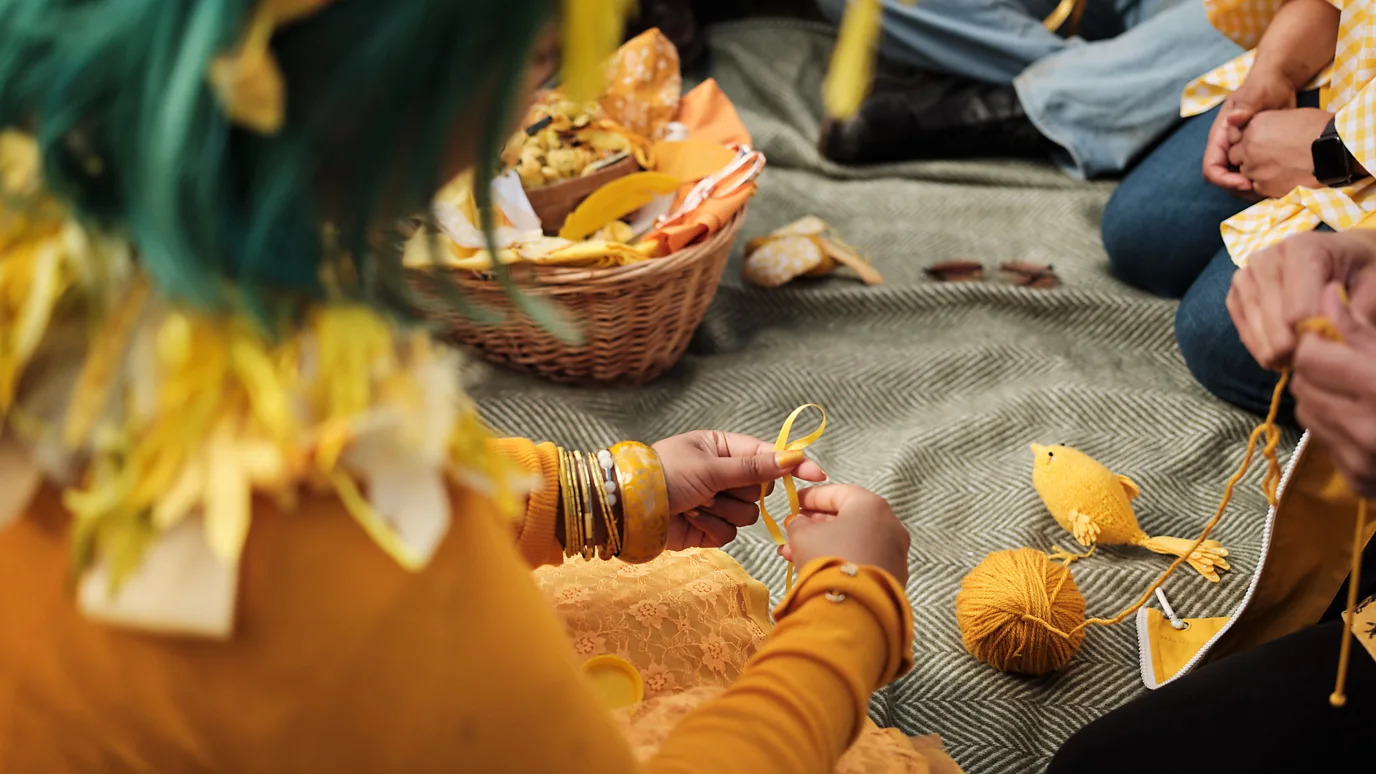
As an introvert who dislikes confrontation, Corbett's activism had been taking a toll on her mental health. As she worked on her cross-stitch on the train and reflected on how she was feeling, the passengers next to her asked what she was doing.
Corbett was stitching a picture of a bear, and saw this as a missed opportunity. "I thought, if only I was stitching a quote by Gandhi, we could talk about inequality," she laughs. "Because my obsession is activism and social change, not craft."
She realised crafts could be a useful tool for starting conversations. This was her starting point for "gentle protest", a form of activism built on a slow, thoughtful approach rooted in empathy and contemplation.
Not long after her train journey, Corbett began researching craft and activism and soon came across the work of Betsy Greer, a knitter and anti-sweatshop activist, who had coined the term "craftivism" in 2003. Since then, craftivism has been taken in different directions by grassroots groups around the world, from straightforward awareness-raising, to punk-inspired "yarn bombing" public spaces by covering trees, lampposts and postboxes with knitted "graffiti".